Custodial vs. Non-Custodial Bitcoin Wallets: Who Holds the Keys?
Part of the guide: Keeping your bitcoin safe
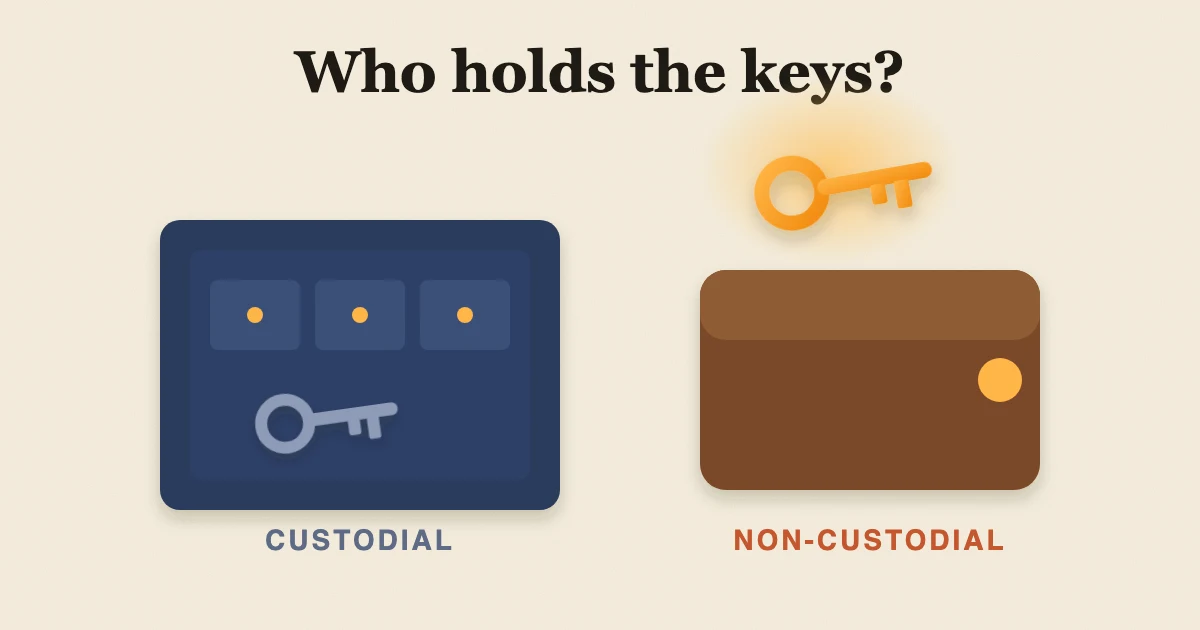
A custodial wallet is like a coat check: someone else holds the coat, and you keep the ticket. A non-custodial wallet is more like carrying the coat yourself. You have more direct control, and nobody else can find it for you if you leave it on the bus.
The 10-second version
- Custodial: a service controls or manages the keys used to access or move the Bitcoin on your behalf; the exact setup depends on the service. You rely on that service to provide access.
- Non-custodial: you control the private keys, often through a recovery phrase managed by your wallet software.
- “Wallet” is a helpful label, but it does not mean the app literally stores coins inside your phone. Bitcoin’s record is on the network; keys authorize spending.
What the keys do
Bitcoin.org’s vocabulary page describes a private key as secret data that proves the right to spend bitcoin from a wallet through a cryptographic signature. A wallet manages keys and helps create and sign transactions. The coins are recorded on the Bitcoin network, not tucked into a digital leather pouch. The pouch is a user interface; the keys are the important part.
Custodial: the service holds the keys
With a custodial service, the company controls the keys on your behalf. You typically sign in to an account and use the company’s interface to view or move your balance. That can feel familiar, much like using an online account. It also means you depend on the company’s security, honesty, and continued ability to give you access.
Bitcoin.org’s wallet security guide warns that when a third party controls your keys, you rely on its security and honesty. It notes that online services and exchanges can be hacked, fail, or freeze access to funds. That is a description of the risk, not a claim that every provider will fail.
In a custodial setup, forgetting your password may be a customer-support problem. If the service has a problem, you may have to wait on its processes. The exact rules depend on the company and the laws that apply. We are not checking any specific service here.
Non-custodial: you hold the keys
With a non-custodial wallet, you control the private keys. The wallet app helps manage them, but the recovery phrase or backup is your responsibility. If your phone breaks, a backup may help restore access, depending on how that wallet works. If the phrase is lost or exposed, the problem can be much harder to fix.
Bitcoin.org recommends backing up the wallet, keeping backups in secure locations, and checking how the wallet handles backups. Its guide says many modern deterministic wallets can be restored from a single recovery phrase, but readers should check their wallet’s own backup process. A “non-custodial” label alone does not guarantee that the wallet is secure or easy to recover.
The trade-off in one picture
Custody shifts key management to a service and makes access depend on that service. Self-custody puts key control with the user and makes backup security the user’s job. One is not automatically right for everyone. The sensible choice depends on how much responsibility someone wants to carry and what risks they understand.
If you use a custodial service, Bitcoin.org suggests choosing it carefully and enabling strong multi-factor authentication when available. If you use a non-custodial wallet, its security guide points to backups, passwords, software updates, and safe storage. Neither arrangement removes every risk. Both need a little care, like locking a door even when the neighborhood seems friendly.
What we did not check
We did not test wallet apps, exchanges, hardware devices, recovery phrases, or any provider’s policies. We did not compare brands or say that a particular wallet is safe. Backup behavior varies by wallet, so the general description should not replace the wallet’s own instructions.
Sources
- Bitcoin.org, Securing your wallet (checked October 19, 2026)
- Bitcoin.org, Vocabulary (checked October 19, 2026)
- Bitcoin.org, Choose your wallet (checked October 19, 2026)