Two small toys for playing with Bitcoin’s rules. Type a number, see what happens. Nothing here is sent anywhere: the math runs in your browser, and we collect nothing.
Little Tools
1. The change maker
A Bitcoin “coin” cannot be cut in half. You spend it whole, and whatever is left after the payment and the fee comes back to you as a new coin. Try your own numbers (in satoshis, the smallest unit).
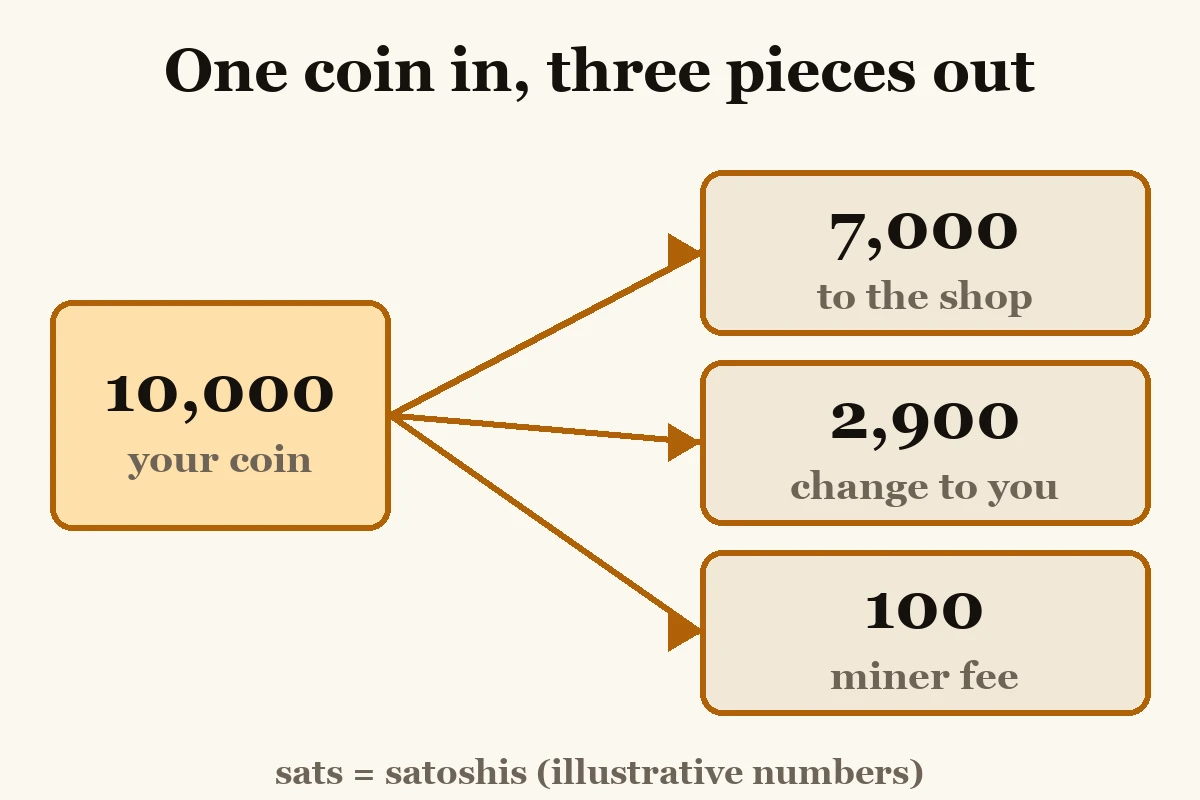
Why it matters: the Bitcoin developer guide explains that each input spends an earlier output, and that the difference between inputs and outputs can become the miner’s fee. So forgetting the change output is an expensive mistake. Sources: Transactions and Block Chain in the Bitcoin developer guide.
2. The halving and supply explorer
Type a block number. We apply the rule from the protocol: the reward starts at 50 BTC and is cut in half every 210,000 blocks. The tool tells you which stretch of the schedule that block is in and how much the schedule has issued by then.
Try 840000 (the block where the reward became 3.125 BTC) or 6929999 (by this formula, the last block that still pays a reward). The prefilled number is the block height when this page was last built.
What this is not: a count of the coins people actually hold today, a price tool, or a forecast of dates. It is just the issuance rule, calculated. The total it approaches is about 20,999,999.9769 BTC, slightly under 21 million, because of how amounts are stored (see the Bitcoin Wiki page on controlled supply).
How these tools are made
The change maker is simple subtraction: coin minus payment minus fee. The explorer uses whole satoshis and integer math, the same way the rule is written, so it does not lose pennies to rounding. Both run entirely on this page. If you spot an error, tell us on the contact page and we will fix it and say so. For the words used here, see the Glossary.