Bitcoin Mining Explained: What Miners Actually Do
Part of the guide: How Bitcoin works
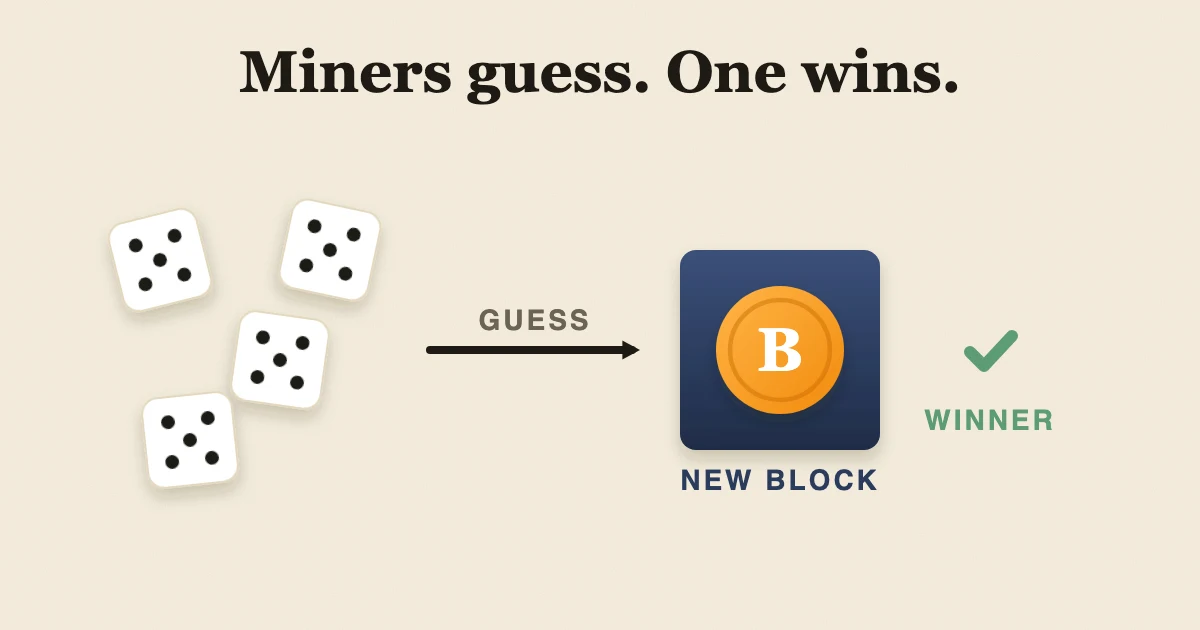
Imagine a room full of people trying combinations on a combination lock. The first person to find one that fits gets to show the room; everyone else can check it quickly. Bitcoin mining is a computer version of that contest, with less dramatic cheering and more fans whirring.
The 10-second version
- Miners collect valid transactions into a candidate block.
- Mining hardware repeatedly hashes the block header, changing values until a hash is below the network's target.
- Other nodes can check the answer quickly. Accepted blocks link to earlier blocks, making the history harder to rewrite.
The Bitcoin Developer Guide says mining adds blocks and makes transaction history hard to modify. The whitepaper's proof-of-work section describes the search as trying values until a hash meets a required threshold. Both checked October 18, 2026.
What miners put in the block
Mining software builds a candidate block from transactions and block data. Bitcoin's developer guide says it sends a block header and target threshold to mining hardware, which tests nonce values and hashes the header.
If a hash is below the target, the miner has a valid proof-of-work candidate and broadcasts the block. Other participants can check it without repeating the search. Finding the answer can take many attempts; checking it is comparatively straightforward.
The whitepaper says changing a block means redoing its proof-of-work and the work of later blocks. This is why “mining secures history” is a shorthand: it raises the work needed to replace older entries, while nodes still check the rules.
Why the race exists
If anyone could announce “I win” without a costly test, a spammer could flood the system with fake histories. Proof-of-work makes proposing a block require computational effort. Nodes then verify that the proposed block meets the rules. The whitepaper explains that proof-of-work also helps the network agree on ordering without relying on a one-IP-address-one-vote system.
Mining adds blocks and distributes the block reward, which the guide says includes a subsidy and transaction fees. We did not measure hardware, pool, fee, or electricity costs, so this is not an earnings calculator.
Difficulty: adjusting the lock
Bitcoin changes the target difficulty so blocks do not become dramatically faster or slower just because more or less computing power is participating. The developer guide says the network adjusts difficulty every 2,016 blocks, using timestamps, with an ideal interval of two weeks for that set. It also describes limits on how much a single adjustment can change.
The Bitcoin Wiki's Difficulty page gives the same general adjustment idea. This is not a promise that an individual block arrives on a timer. A block can take longer or shorter than the average.
Solo mining and pools
A solo miner tries to find a block alone and keeps the proceeds if successful, but payments can be less regular. A pool combines miners' work and shares proceeds according to contributed hashing power. The developer guide describes this trade-off as larger, less frequent solo payouts versus smaller, more frequent pool payouts. It does not make either path a guaranteed profit plan.
The Bitcoin Wiki's Mining page also describes pools as a response to uncertainty when finding blocks individually.
What we did not check
We did not calculate today's mining revenue, electricity use, emissions, or profitability. We did not inspect current mining hardware or pool fees. No energy figure appears here because we did not verify a suitable primary source for one. Mining is not a guaranteed income stream.
Sources
- Bitcoin Developer Guide: Mining (checked October 18, 2026)
- Bitcoin Developer Guide: Block Chain (checked October 18, 2026)
- Bitcoin whitepaper (checked October 18, 2026)
- Bitcoin Wiki: Mining (checked October 18, 2026)
- Bitcoin Wiki: Difficulty (checked October 18, 2026)