Proof of Work vs. Proof of Stake, Explained Simply
Part of the guide: How Bitcoin works
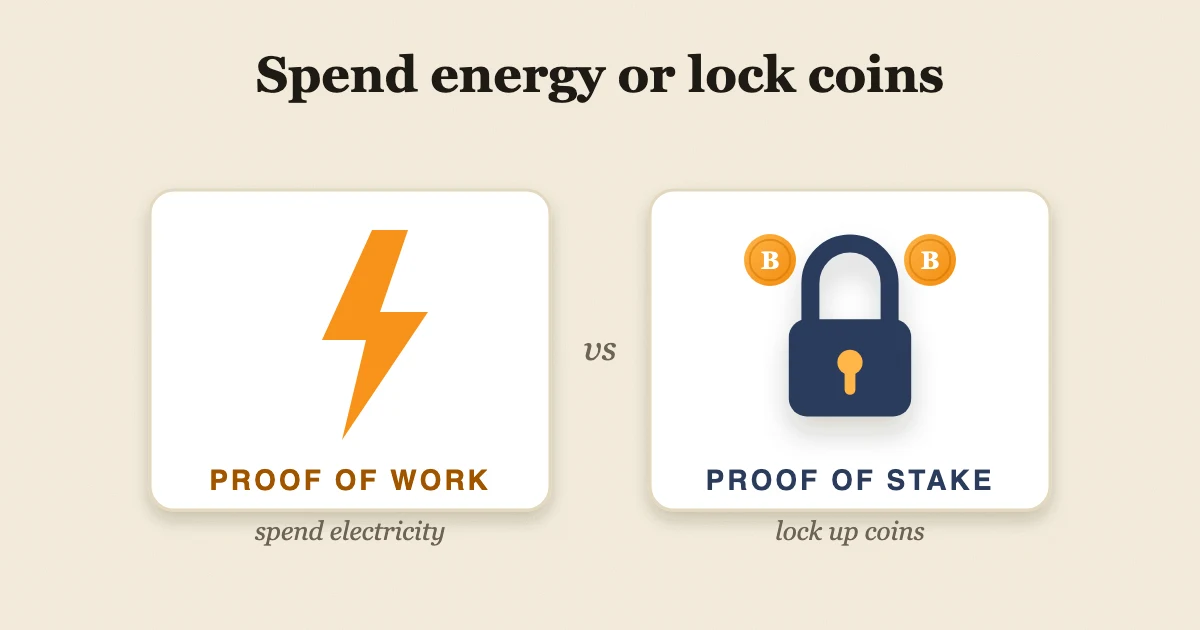
Imagine a neighborhood deciding which page goes into the shared scrapbook. In one system, people race to solve a tough puzzle. In another, selected reviewers put up a deposit and check each other’s work. That is the rough shape of proof of work and proof of stake.
The 10-second version
- Proof of work (PoW): miners compete to find a valid hash for a block. The network can check the answer quickly, and changing old records means doing more work.
- Proof of stake (PoS): validators lock up an asset, check proposed blocks, and can lose some of that stake for dishonest behavior.
- These are different ways to organize agreement. They do not make every transaction safe from every mistake, scam, bug, or bad decision.
Proof of work: a puzzle race
Bitcoin’s whitepaper describes proof of work as scanning for a value that makes a block’s hash satisfy a target. The process involves many attempts. Checking a proposed answer is much easier than finding it. That difference lets the network reject invalid blocks without asking everyone to trust the miner.
The Bitcoin developer guide explains how each block points to the previous block. A miner who wants to alter an older block has to redo proof of work for that block and the later ones that build on it. As new blocks are added, the work needed to change old history grows.
Mining is the name for this block-creation process. Miners gather transactions into candidate blocks and search for a hash under the target. If they find one, nodes still check the block against Bitcoin’s rules. A miner cannot make an invalid transaction valid just by winning a puzzle race. The nodes have their own rulebook and can say, “Nice try, but no.”
Proof of stake: a deposit and a referee job
Ethereum now uses proof of stake. Its official documentation says validators stake ETH in a smart contract. Validators check new blocks and sometimes propose them. If they try to cheat, some or all of their staked ETH can be destroyed under the protocol’s rules.
Validators are not simply picked because they own a shiny badge. The network follows rules for proposing blocks and voting on them. Ethereum’s documentation describes selected validators proposing blocks and other validators attesting to them. Rewards encourage correct participation; penalties discourage dishonest behavior.
Think of a referee who puts a bond on the table before the game. The bond gives the referee something to lose by cheating. It does not prove that every referee is wise, every rule is perfect, or every game will be drama-free. It just describes a different security mechanism.
What is being spent?
In proof of work, miners spend computing effort and electricity to search for valid hashes. In proof of stake, validators commit capital that can be penalized if they break protocol rules. Ethereum’s explainer compares these as different resources used to discourage attacks. We are not adding an energy estimate here: the exact number would depend on a measurement method and a specific date, and the cited pages do not provide a universal figure.
Neither model is a magic shield. PoW depends on honest nodes checking rules and miners contributing work. PoS depends on validators following the protocol and the network applying its penalties. The two systems make different trade-offs in how participation and security are organized.
What we did not check
We did not calculate network energy use, operating costs, attack costs, or decentralization scores. We did not test a node or validator. We also did not claim that one mechanism is best for every blockchain. Ethereum’s documentation describes Ethereum’s PoS design; other networks can use different rules.
Sources
- Bitcoin.org, Bitcoin: A Peer-to-Peer Electronic Cash System (checked October 19, 2026)
- Bitcoin Developer Guide, Block Chain (checked October 19, 2026)
- Ethereum.org, Proof of Stake (checked October 19, 2026)
- Ethereum.org, Consensus Mechanisms (checked October 19, 2026)