What Is a Bitcoin ETF? A Beginner’s Guide to Spot Bitcoin ETPs
Part of the guide: Money, law and markets
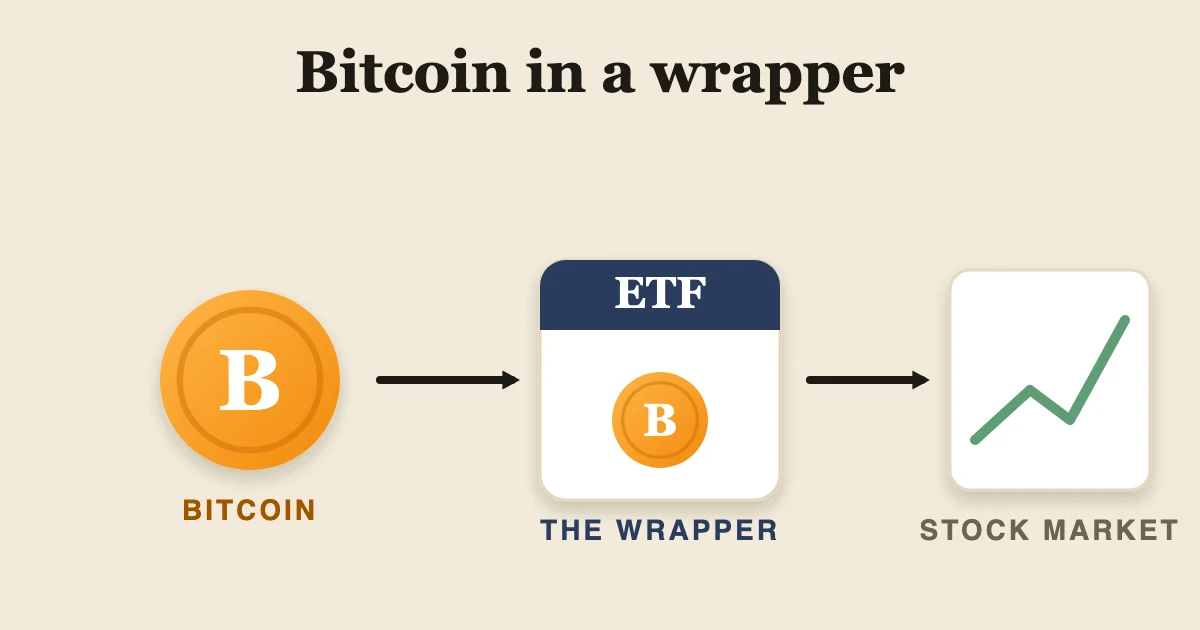
A spot Bitcoin fund is a bit like a coat-check ticket. The coat stays with the coat-check desk; you hold a claim connected to it. The question is what that ticket represents.
The 10-second version
- A spot Bitcoin exchange-traded product (ETP) holds Bitcoin and offers shares that trade on a securities exchange.
- A buyer owns shares in the trust or product, not Bitcoin keys in a personal wallet.
- People often call these products “Bitcoin ETFs,” but the SEC’s investor bulletin says spot Bitcoin ETPs are structured as commodity trusts, not ETFs registered under the Investment Company Act of 1940.
On January 10, 2024, the SEC said it approved the listing and trading of certain spot Bitcoin ETP shares. The statement says that approval did not endorse the products or their custody arrangements. Read the SEC statement.
What “spot” means
“Spot” means the product holds the crypto asset itself, rather than futures contracts linked to it. The SEC’s Investor.gov bulletin describes spot Bitcoin ETPs as exchange-traded commodity trusts that hold Bitcoin. The product aims to give investors exposure to Bitcoin without requiring them to transact directly on a crypto platform or manage private keys themselves. Convenience comes with a wrapper: shares, a sponsor, custody, fees, and product rules.
What the buyer owns
When someone buys a share through a brokerage account, they own a share issued by the trust. They do not receive a Bitcoin address or the private keys that control the trust’s Bitcoin. The trust’s Bitcoin is held under its custody arrangements. Investors rely on the product’s legal structure and service providers, as described in its prospectus.
The Bitwise Bitcoin ETF prospectus filed with the SEC says the trust holds Bitcoin and issues shares listed on NYSE Arca. It also says buyers place orders through brokers. The share is the thing changing hands in that brokerage trade. The prospectus describes the trust’s operations, fees, custody, risks, and how shares are created or redeemed. Details can differ by product.
What the buyer does not own
Buying a share does not mean you can sign a Bitcoin transaction from the trust’s wallet. You do not personally hold its private keys, and you cannot use that share to pay a shop directly on the Bitcoin network. The share is a financial product linked to a trust that holds Bitcoin. It is not a self-custody wallet with a Bitcoin balance you control on-chain.
This changes the risks. With a brokerage product, you deal with a broker and depend on the trust’s sponsor, custodian, and other arrangements. With direct Bitcoin ownership, a wallet’s keys let the holder authorize spending, but that also makes the holder responsible for key security and recovery. Investor.gov says ETPs may avoid some direct risks of handling keys, while still carrying product-specific and market risks.
Why the label can confuse people
“ETF” is the popular shorthand. The SEC bulletin is more precise: spot Bitcoin ETPs are commodity trusts and are not registered as investment companies under the Investment Company Act of 1940, even when the product name or everyday conversation uses “ETF.” Different legal categories can come with different rules. The label on a phone screen does not tell the whole story; the prospectus does.
This is not just paperwork. The bulletin points readers to the prospectus and periodic reports on EDGAR so they can check the product’s own risks, fees, and arrangements. SEC registration statements require disclosures, but the Commission has said that approval of listings does not endorse an ETP’s custody arrangements.
What we did not check
We did not compare every spot Bitcoin product, broker, fee schedule, tax treatment, or custody provider. We did not check whether a product is available in a reader’s country or account. The Bitwise prospectus is one example, not a universal template. We also did not assess whether any product fits anyone’s situation.
Sources
- SEC, Statement on the Approval of Spot Bitcoin Exchange-Traded Products (checked October 19, 2026)
- Investor.gov, ETPs Providing Exposure to Bitcoin and Ether (checked October 19, 2026)
- SEC EDGAR, Bitwise Bitcoin ETF Prospectus (checked October 19, 2026)