Fees and the Mempool: Bitcoin's Waiting Room
Part of the guide: How Bitcoin works
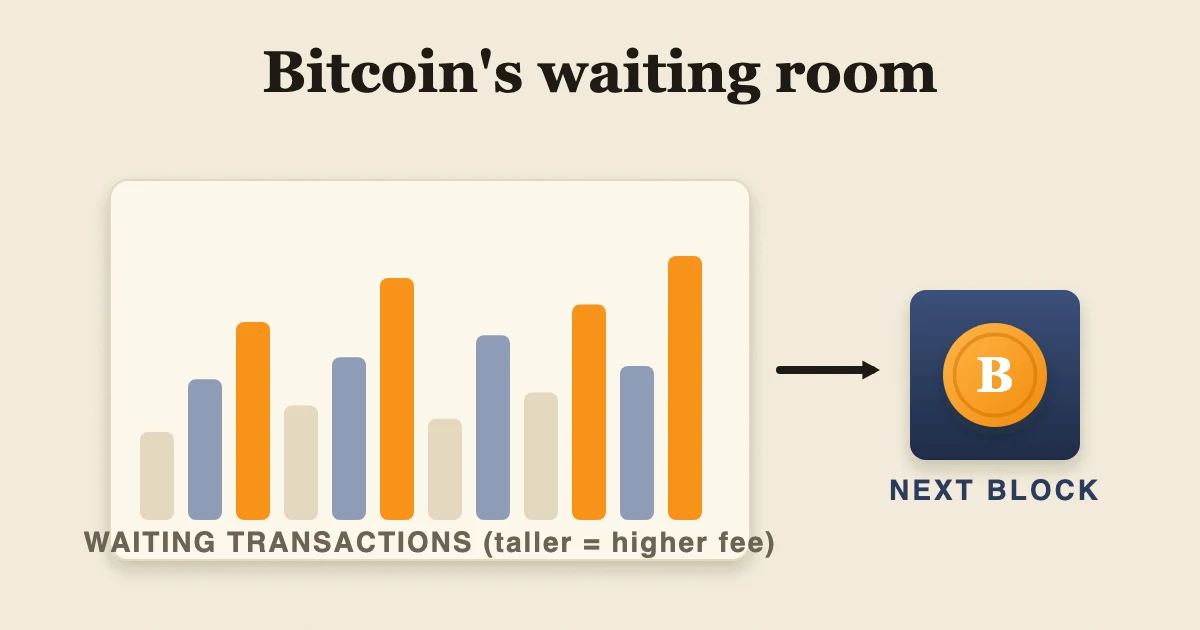
Picture a busy deli with a line of tickets. Your order can be waiting before the cook starts it. Bitcoin has a similar waiting area for unconfirmed transactions. The analogy gets hungry quickly, but it helps.
The 10-second version
- A mempool is a node's collection of eligible unconfirmed transactions. It is not one permanent, universal waiting room.
- Transactions compete for limited block space. Fees help miners choose which transactions to include.
- A fee estimate is an estimate, not a delivery appointment. Demand and local node policy matter.
Full peers may track eligible unconfirmed transactions. Bitcoin Core stores these in non-persistent memory, called a memory pool or mempool. If a peer shuts down, that pool can be lost, and transactions may disappear as peers restart or make room. Bitcoin Developer Guide, P2P Network: Memory Pool (checked October 18, 2026).
Why pay a fee?
A transaction spends earlier outputs. If its inputs are worth more than its outputs, the difference can be claimed as a fee by the miner whose block includes it. Fees depend on signed transaction size and demand for block space. Each miner chooses the minimum fee they will accept.
So a fee is not a tip to a central Bitcoin cashier. Miners can prefer transactions with more fee for the space they use. When space is busy, competition can push fees upward. Relay rules and miners' choices mean there is no clerk promising every transaction the same wait. Bitcoin Developer Guide, Block Chain; Bitcoin Developer Guide, Transactions: Fees and Change (checked October 18, 2026).
Each node has its own waiting room
It is tempting to imagine one giant mempool where every pending transaction sits in the same line. Full peers can track eligible transactions, and Bitcoin Core's pool is non-persistent memory. Nodes can see different transactions or clear their pools at different times. A transaction in one node's pool is not yet a permanent blockchain entry.
Once transactions are mined into a block, they leave the pool as confirmed transactions. Transactions from stale blocks may be added back temporarily, then removed if replacement blocks include them. The line can rearrange; it is not carved into stone. Bitcoin Developer Guide, P2P Network: Memory Pool.
What fee estimates can and cannot say
Bitcoin Core's estimatesmartfee RPC estimates a fee rate for a transaction to begin confirmation within a requested block target, if possible. It also returns how long that estimate is valid. “Estimate” and “if possible” are not a promise. Network conditions can change.
Fees can help estimate how long inclusion may take. Neither source tells us what a fee should be right now, so this article gives no live number. Bitcoin Core, estimatesmartfee RPC; Bitcoin Developer Guide, Payment Processing (checked October 18, 2026).
What we did not check
We did not query a live node, compare current fee estimates, or check how any wallet chooses a fee. The RPC page documents a tool; it is not a live quote. A transaction's actual wait can vary with network conditions and miner choices.
Sources
- Bitcoin Developer Guide: P2P Network, Memory Pool (checked October 18, 2026)
- Bitcoin Developer Guide: Block Chain (checked October 18, 2026)
- Bitcoin Developer Guide: Transactions, Fees and Change (checked October 18, 2026)
- Bitcoin Core:
estimatesmartfeeRPC (checked October 18, 2026) - Bitcoin Developer Guide: Payment Processing (checked October 18, 2026)