Bitcoin Address Types Explained: Legacy, SegWit and Taproot
Part of the guide: How Bitcoin works
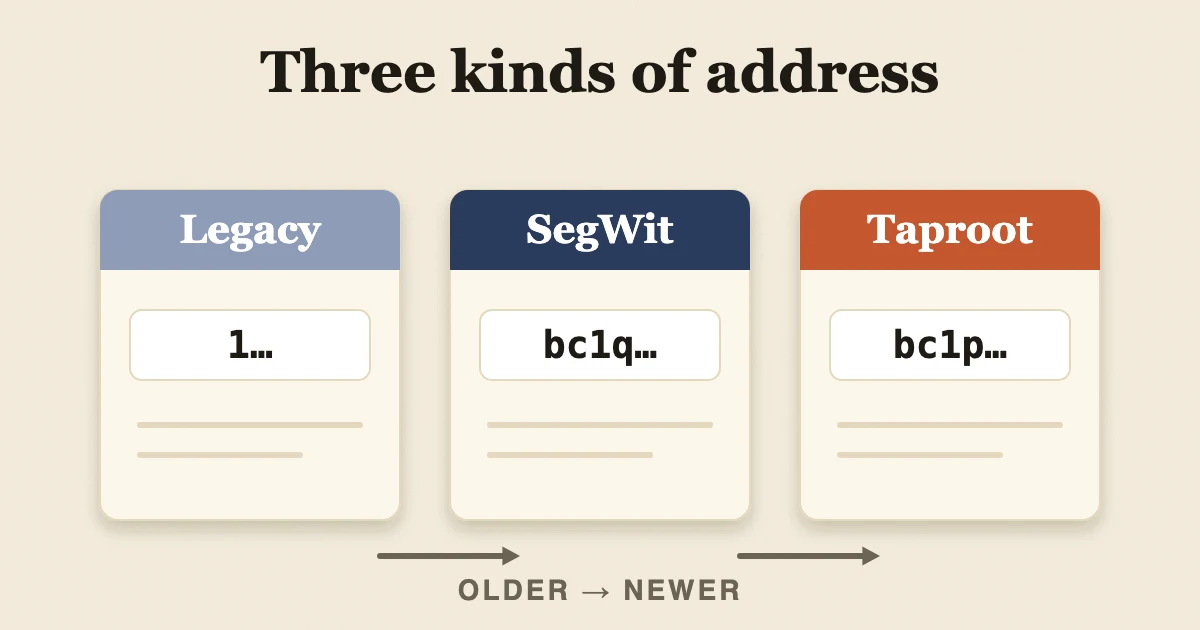
A Bitcoin address is like a delivery label for a payment. Different label formats can point to different kinds of spending rules, much as a parcel can need a signature or fit a different locker. The label is not the parcel, and a typo can send it to the wrong place.
The 10-second version
- An address is a human-friendly encoding of information used to create a payment output. It is not a username or a complete account.
- Older Base58Check addresses are commonly called legacy or P2SH formats. SegWit introduced witness outputs, with bech32 used for version 0.
- Bech32m is used for witness version 1 and later. A wallet must support the format and output type you send to.
The Bitcoin Developer Guide explains how addresses encode data for payment. BIP-173 specifies Bech32, while BIP-350 specifies Bech32m. Links checked October 18, 2026.
First, what does an address do?
The developer guide says Bitcoin transactions pay to a conditional public-key script. An address is a convenient way to share information that helps create that output. The guide describes older Base58-encoded addresses as carrying a version number, a hash, and a checksum that can catch some typing errors. That makes the address more like a formatted instruction than a bank account number.
An address does not reveal identity by itself, but that does not make payments private. Bitcoin.org says public transactions can sometimes be linked to people depending on how Bitcoin is used.
Legacy and P2SH: the older-looking labels
Legacy is a common informal label for older address formats. The developer guide describes Base58Check encoding. Pay-to-script-hash, or P2SH, lets a payment be locked to a hash of a script, with the spending conditions supplied later. SegWit also has a wrapped form that uses a P2SH address. So “P2SH” does not automatically mean “old technology”; it can describe how a newer witness payment is wrapped.
Prefixes are clues, not a complete decoder. Wallets can differ in supported formats. Check the network shown in your wallet; mainnet and test-network addresses are not interchangeable.
Bech32: SegWit version 0
BIP-173 defines Bech32 as a checksummed base-32 format for native witness outputs. In ordinary Bitcoin use, version 0 witness outputs include P2WPKH and P2WSH. BIP-141 describes those script rules and distinguishes native witness outputs from witness programs wrapped in P2SH.
A bech32 address uses a human-readable prefix for the network and a data part with a checksum. On Bitcoin mainnet, these addresses commonly begin with bc1q; the precise format rules are in the BIP, not in the first two characters alone. The checksum helps detect certain errors. It cannot rescue a payment sent to a valid but unintended address.
Bech32m: version 1 and later
BIP-350 defines Bech32m, an improved variant. It says Bech32 remains in use for witness version 0, while Bech32m is used for version 1 and later. Taproot outputs use witness version 1, so their addresses use the Bech32m checksum format. On mainnet they commonly begin bc1p.
That difference helps software distinguish address types. No format is universally best for every sender and receiver. Compatibility matters: use a destination supported by both sides.
A quick safety check
Copy the address from the receiving wallet, confirm the network, and compare the start and end after pasting. If the app shows a QR code, scan it and still verify the displayed destination. Do a small test only when appropriate for your situation; network fees and wallet policies vary. We are describing general checks, not promising that a transaction can be reversed.
What we did not check
We did not test every wallet's address support, fees, or recovery process. We did not claim every prefix uniquely proves a script type. The BIPs are technical standards; wallets can differ in how they present formats.
Sources
- Bitcoin Developer Guide: Transactions (checked October 18, 2026)
- BIP-173: Bech32 (checked October 18, 2026)
- BIP-350: Bech32m (checked October 18, 2026)
- BIP-141: Segregated Witness (checked October 18, 2026)
- Bitcoin for Individuals (checked October 18, 2026)